
Our Church Building: Design of the Church
Explore the beauty, symbolism, and sacred design of Saint George Greek Orthodox Church through this virtual tour. Rooted in centuries of Orthodox tradition, the church’s architecture reflects a deep connection between heaven and earth. As you move through the space, you will see how every feature, from the dome above to the icons within, expresses the theology and worship of the Orthodox Christian faith.
Byzantine Architecture and Sacred Design
Eastern Orthodox churches follow a distinct architectural style. Most feature a dome set on a cross-shaped or basilica layout. Saint George takes inspiration from the Great Church of Christ, known as Hagia Sophia in Constantinople, modern-day Istanbul. Because of this influence, the church connects directly to the long history of Orthodox Christian worship and tradition.
Unlike Western churches, which often use steeples or spires, Orthodox churches focus on domes. These domes are not just structural. Instead, they symbolize the union of heaven and earth. As a result, the dome reminds worshippers that the liturgy brings together both realms.
The dome of Saint George uses interlocking copper plates and includes 24 windows. Because of this design, light fills the space and creates a glowing effect similar to Hagia Sophia’s “floating” dome.
The dome measures 30 feet across inside and 34 feet outside. It rises 55 feet from the floor. Above it, a cross reaches 60 feet into the air. This cross represents the strength and holiness of Christ’s Church.
Architects Sam Grillas and Mark Lawrence of Grillas, Pirc, Roser and Alves designed Saint George in Irvine, California. The church spans about 10,000 square feet and seats 383 people. Together, these features create a space that reflects both beauty and purpose.
Interior of the Church
The interior of Saint George forms a Greek Cross with four equal arms. The church includes three main areas: the Narthex, the Nave, and the Sanctuary. Each space plays a different role in worship. At the same time, all three work together to guide the spiritual experience.
The Narthex
The Narthex serves as the entry space of the church. Here, visitors prepare before entering the main worship area. This transition helps shift focus from daily life to prayer.
Inside the Narthex, you will find a sand urn for candles and stands for icons. When people enter, they often light candles and venerate an icon. This practice carries deep meaning. For example, candles represent Christ as the Light of the World. In addition, they remind each person to reflect that light in everyday life.
Icons also play an important role. They invite prayer and reflection while connecting worshippers to the saints and events of the faith. To learn more, visitors can explore the parish’s Orthodox faith resources.
The Narthex windows draw inspiration from the Church of St. Anna in Heraklion, Crete, built in 1555. Because of this, Saint George connects to a much older artistic tradition within Orthodoxy.
The Nave
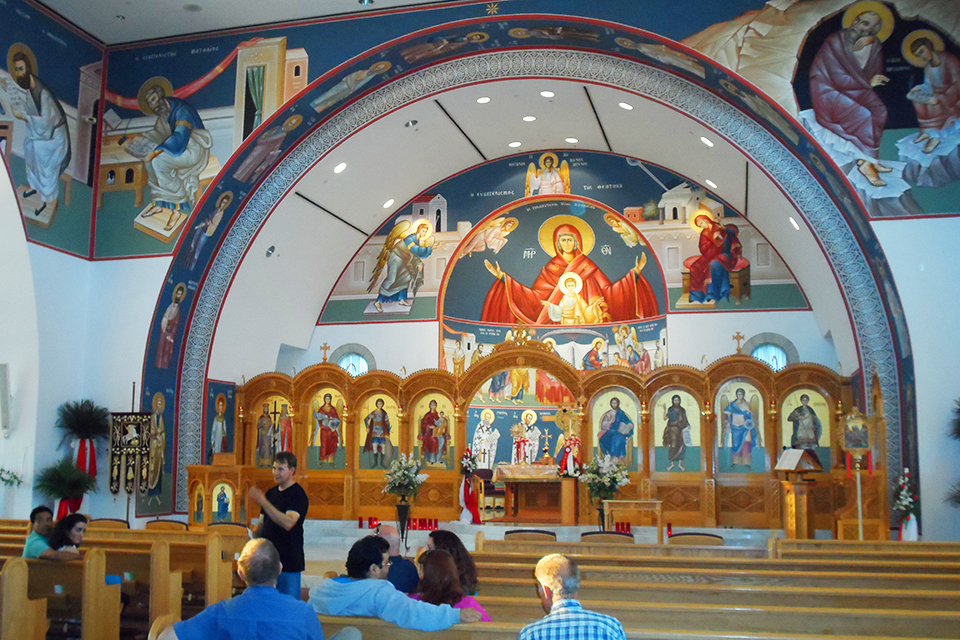
The Nave is the largest space in the church. Here, the congregation gathers for prayer, worship, and sacraments. Rather than simply a seating area, the Nave brings the community together in shared participation.
The Solea
Between the Nave and the Altar lies the Solea, a raised platform. Many services take place here. While the Divine Liturgy, Matins, and Vespers remain central, other sacraments also happen in this space. Because of this, the Solea plays a key role in church life.
The Nave also reflects the communal nature of Orthodox worship. People gather here for Sunday services, feast days, and important life events. For current services, visitors can view the church calendar and schedule.
The Sanctuary
The Sanctuary is the holiest part of the church. It sits behind the Iconostasion, also called the Icon Screen. This screen separates the sacred altar area from the Nave. At the same time, it symbolizes the veil of the Old Testament temple.
The Iconostasion
The Iconostasion displays icons arranged in a traditional order. These icons do not aim for realism. Instead, they present spiritual truths through stylized imagery.
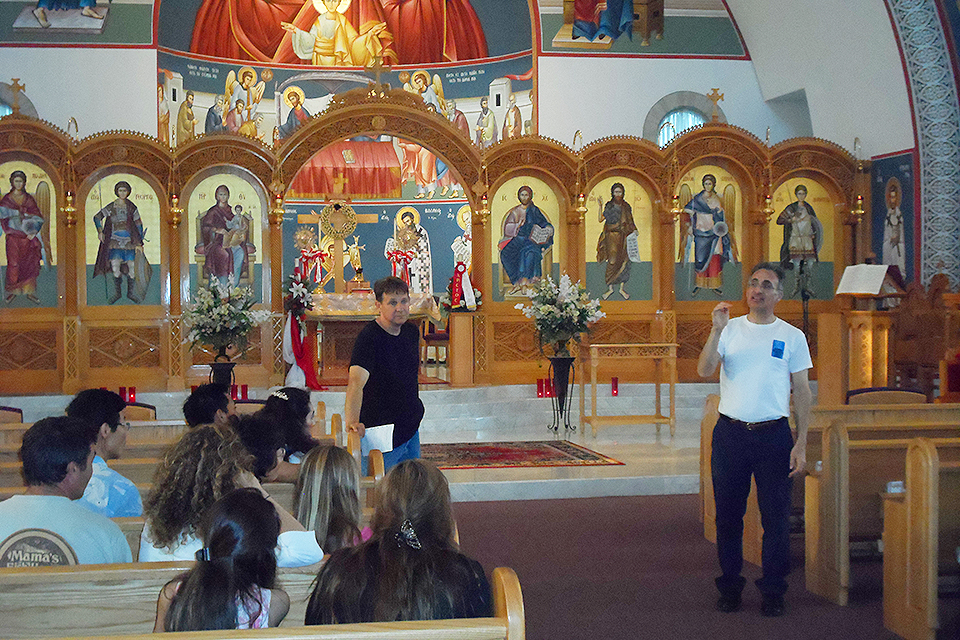
On the right side, you will find Christ, St. John the Baptist, Archangel Gabriel, and St. Demetrios. On the left, you will see the Virgin Mary, St. George, Archangel Michael, and Saints Constantine and Helen. Together, these icons tell the story of salvation and guide prayer.
The Holy Table and Altar
The Holy Table stands at the center of the Sanctuary. It represents the Tomb of Christ. During consecration, the Church places relics of martyrs inside it. This honors early Christians who worshipped among the tombs of the faithful.
On the Holy Table, you will find the Tabernacle, the Antimension, two candlesticks, and the Holy Gospel. Behind it stands a large wooden cross with the image of Christ.
To the left, the Table of Preparation holds the Chalice and Paten. Here, the bread and wine are prepared for the Divine Liturgy.
Liturgical Features
On the right side of the Solea sits the Bishop’s Throne. When present, the bishop sits here. The throne displays an icon of Christ as High Priest.
On the left side, the Pulpit serves as the place where the deacon proclaims the Gospel. Because of this, both areas support the flow of the Divine Liturgy.
Experience the Virtual Tour
This virtual tour offers a deeper look at the beauty and meaning of Saint George Greek Orthodox Church. Each element, from the dome to the Sanctuary, reflects Orthodox theology and tradition.
Whether you are learning about Orthodox architecture or exploring the meaning behind each space, Saint George offers a powerful and meaningful experience.
Contact Us
10830 Downey Avenue, Downey, CA 90241-3720